
The race to adopt AI is no longer optional—it’s essential for survival. Yet, many enterprises are falling into the trap of fragmented AI implementations, treating it as a collection of disconnected tools. Conversational AI here, predictive analytics there, robotic process automation (RPA) in another silo. This piecemeal approach is a recipe for inefficiency and stagnation. Why? Because AI isn’t just another technology—it’s a transformative operating model that requires rethinking how people, processes, and tools work together.
Take a closer look at today’s reality: the lines between software engineers, data engineers, and machine learning engineers are blurring. Back-office functions like finance, HR, and compliance can no longer operate in isolation. And those siloed AI “pilots” you’ve been running? They won’t scale to deliver enterprise-wide impact.
What’s Holding Enterprises Back?
Let’s break down the core challenges enterprises face in adopting AI effectively:
- Siloed Implementations
- Blurring Roles, Unclear Ownership
- Legacy Drag
- Ethical and Operational Risks
The Cognitive Enterprise Architecture Framework (CeAF)
So, what’s the solution? Enterprises need a unified framework that harmonizes these elements into a cohesive strategy. Enter the Cognitive Enterprise Architecture Framework (CeAF)—a structured blueprint designed to embed intelligence across every layer of an organization. CeAF isn’t just about deploying AI; it’s about creating an adaptive ecosystem where humans and machines collaborate seamlessly to drive innovation and efficiency.
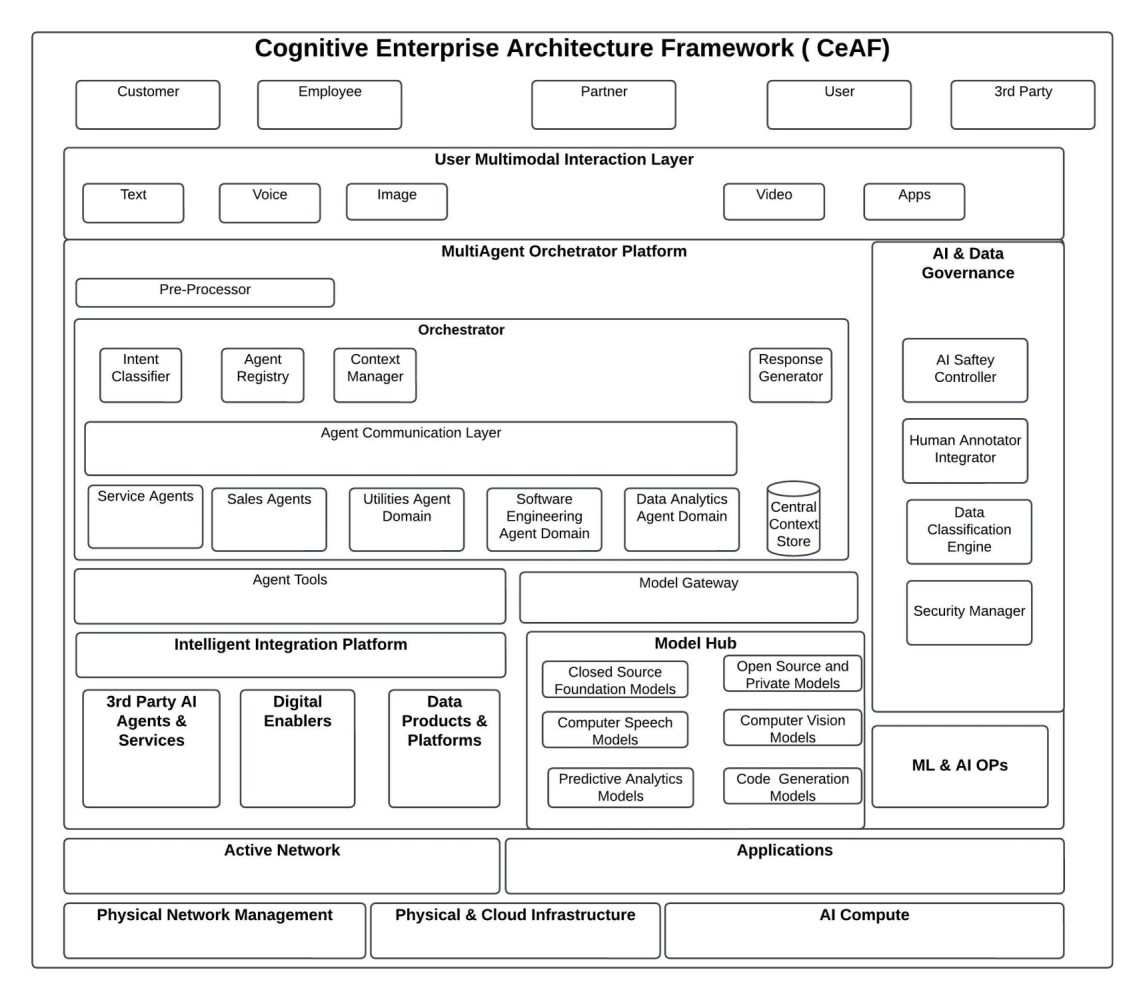
Here’s how CeAF addresses the challenges:
1. User Multimodal Interaction Layer
- Enables intuitive interactions across voice, text, and visual channels with omnichannel consistency.
- Delivers personalized user experiences driven by real-time data.
2. Multi-Agent Orchestrator Platform (MOP)
- Acts as the “central nervous system” for intelligent workflow orchestration.
- Dynamically allocates tasks to specialized AI agents while ensuring compliance and ethical governance.
3. Data Products and Platform
- Breaks down silos by unifying disparate data sources into a single access layer.
- Leverages tools like knowledge graphs and synthetic data generation for actionable insights.
4. Digital Enabler Layer
- Bridges legacy systems with modern AI-driven engagement tools.
- Powers personalized customer journeys and real-time decision-making.
5. Application Layer
- Transforms legacy systems into modular, cloud-native architectures with embedded intelligence.
- Embeds predictive analytics directly into business workflows.
6. AI Compute Layer
- Provides scalable infrastructure for deploying diverse AI models.
- Supports both cloud-based and on-premise compute environments.
7. Active and Intelligent Network Systems (For Telcos)
- Enables self-healing networks with dynamic resource allocation for real-time optimization.
- Particularly transformative for industries like telecommunications.
8. AI Governance Layer
- Ensures ethical, secure, and compliant use of AI through bias detection protocols and human oversight mechanisms.
9. Intelligent Integration Platform
- How concepts like Model Context Protocol (MCP) have started shaping the integration between agents, models and tools, making it easier for enterprises to address integration challenges.
10. Model Hub
- By centralising AI model management, the Model Hub ensures that agents always have access to the latest, most effective models while maintaining compliance with governance policies and operational standards
Why CeAF Is a Game-Changer
Unlike siloed approaches that fail to scale or align with business goals, CeAF offers a modular yet interconnected framework tailored for enterprise-wide transformation. It modernises legacy systems while embedding governance at every level—ensuring scalability without compromising ethics or security.
What’s Next? A Daily Deep Dive Into CeAF
Starting tomorrow, I’ll explore each layer of CeAF in detail through a daily series:
Multi-Agent Orchestration: Building intelligent workflows that adapt in real-time.
Data Products: Turning fragmented data into strategic assets. …and much more!
Final Thoughts: Architecting Intelligence
AI isn’t just another tool—it’s the foundation of a new operating model that will define the next generation of enterprises. The future belongs to those who architect intelligence into their DNA by adopting frameworks like CeAF.
Stay tuned as we embark on this transformative journey together! Feel free to add your views on how this framework could be enhanced further!
 Cognitive Enterprise