The Pre-Processor Layer: Making AI Smarter, One Input at a Time

In my previous LinkedIn article, “The AI Adoption Imperative: Why Enterprises Need a Unified Framework,” I introduced the Cognitive Enterprise Architecture Framework (CeAF)—a structured approach to embedding intelligence across organizations. Today, let’s dive deeper into one of its foundational components: the Pre-Processor Layer, the intelligent gateway that makes AI-driven workflows possible by handling diverse customer inputs seamlessly.

The Pre-Processor Layer: Making AI Smarter, One Input at a Time

Think about how you interact with businesses today compared to just a few years ago. You might still want the same things—buying a new phone, upgrading your broadband tariff, or getting help when your internet slows down—but the way you do these tasks has changed dramatically. Now, instead of just calling customer service, you might snap a photo of your router’s blinking lights or send a voice note asking, “Why is my internet slow?”

This shift toward diverse, multimodal interactions is exactly why enterprises need something called the Pre-Processor Layer—a key component of the Multi-Agent Orchestrator Platform (MOP) within the Cognitive Enterprise Architecture Framework (CeAF).

Why Does the Pre-Processor Layer Matter?

Customers today communicate using text, images, voice notes, videos, and even sensor data from IoT devices. Without an intelligent way to handle these varied inputs, businesses risk inefficiencies and poor customer experiences. The Pre-Processor Layer solves this by:

  • Normalizing Inputs: Converting raw data (like voice notes or screenshots) into structured formats such as JSON.
  • Adding Context: Enriching inputs with metadata like timestamps and customer IDs to ensure accurate downstream processing.
  • Multimodal Fusion: Combining insights from multiple input types (e.g., audio and images) to create a unified understanding.
  • Real-Time Streaming: Managing interactions quickly and seamlessly to deliver immediate responses.

What Exactly Does the Pre-Processor Do?

Let’s break down some of its key functionalities in simple terms:

  1. Image Processing:
  2. Audio Processing:
  3. Video Processing:
  4. Sensor Data Processing:
  5. Multimodal Fusion:

A Real-Life Scenario: Broadband Customer Support

Imagine you’re frustrated with slow internet speeds. You send your broadband provider a quick voice note—”Why is my internet slow?”—along with a screenshot showing disappointing speed test results.

Here’s how the Pre-Processor Layer handles it:

  1. Voice-to-Text Conversion: Your voice note is transcribed into text instantly.
  2. Image Analysis: The screenshot is analyzed automatically to extract precise metrics like download/upload speeds and latency.
  3. Contextual Enrichment: Additional information—your customer ID, timestamp, previous service history—is added for context.
  4. Combining Insights: The system merges your transcribed question and extracted screenshot metrics into one structured format.
  5. Actionable Output: A neatly packaged JSON file is sent downstream to diagnostic agents who quickly identify your issue and propose solutions.

Best Practices for Implementing the Pre-Processor Layer

To ensure this layer works seamlessly, enterprises should:

  • Support diverse input types (text, audio, images) for flexibility.
  • Dynamically select optimal AI models based on specific tasks.
  • Add contextual metadata to enhance accuracy.
  • Ensure compliance with privacy standards like GDPR through anonymization.
  • Optimize workflows for scalability and low-latency performance.

Key Architecture Principles

The Pre-Processor Layer should be built on principles such as:

  • Modularity: Separate modules for each input type for easy scaling.
  • Extensibility: Easy integration of new AI models without disrupting existing workflows.
  • Error Resilience: Fallback mechanisms (like human annotations) for ambiguous inputs.
  • Real-Time Processing: Prioritise low-latency operations for immediate responsiveness.

Wrapping Up

The Pre-Processor Layer isn’t just another technical component—it’s the intelligent gateway that makes modern customer interactions seamless and efficient. By transforming diverse multimodal inputs into structured insights enriched with context, it empowers enterprises to deliver faster, smarter, and more personalized experiences.

In the next week’s article, we’ll dive deeper into how the Orchestrator—the “brain” behind MOP—uses these processed inputs to drive intelligent decision-making across your organization.

The AI Adoption Imperative: Why Enterprises Need a Unified Framework?

The race to adopt AI is no longer optional—it’s essential for survival. Yet, many enterprises are falling into the trap of fragmented AI implementations, treating it as a collection of disconnected tools. Conversational AI here, predictive analytics there, robotic process automation (RPA) in another silo. This piecemeal approach is a recipe for inefficiency and stagnation. Why? Because AI isn’t just another technology—it’s a transformative operating model that requires rethinking how people, processes, and tools work together.

Take a closer look at today’s reality: the lines between software engineers, data engineers, and machine learning engineers are blurring. Back-office functions like finance, HR, and compliance can no longer operate in isolation. And those siloed AI “pilots” you’ve been running? They won’t scale to deliver enterprise-wide impact.

What’s Holding Enterprises Back?

Let’s break down the core challenges enterprises face in adopting AI effectively:

  1. Siloed Implementations
  2. Blurring Roles, Unclear Ownership
  3. Legacy Drag
  4. Ethical and Operational Risks

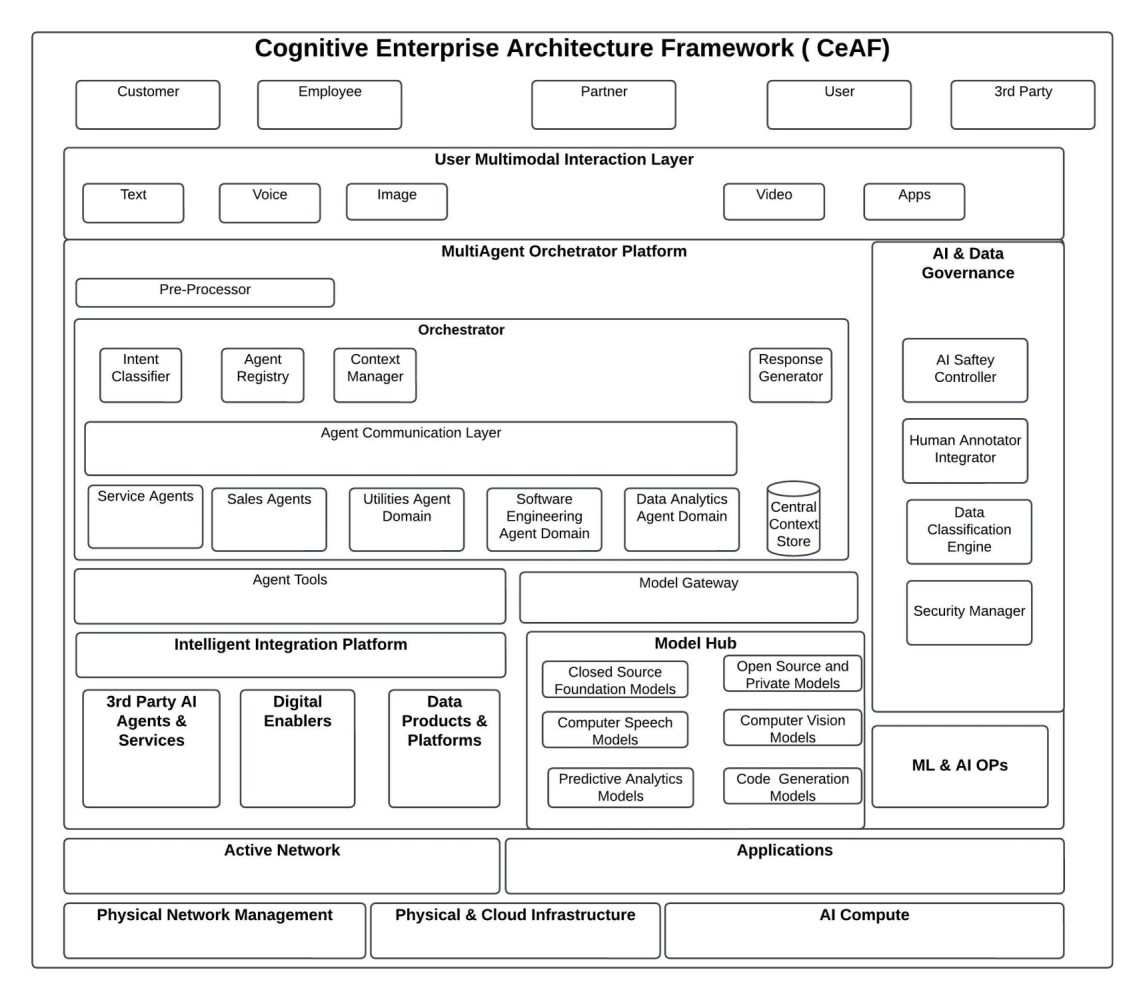
The Cognitive Enterprise Architecture Framework (CeAF)

So, what’s the solution? Enterprises need a unified framework that harmonizes these elements into a cohesive strategy. Enter the Cognitive Enterprise Architecture Framework (CeAF)—a structured blueprint designed to embed intelligence across every layer of an organization. CeAF isn’t just about deploying AI; it’s about creating an adaptive ecosystem where humans and machines collaborate seamlessly to drive innovation and efficiency.

Here’s how CeAF addresses the challenges:

1. User Multimodal Interaction Layer

  • Enables intuitive interactions across voice, text, and visual channels with omnichannel consistency.
  • Delivers personalized user experiences driven by real-time data.

2. Multi-Agent Orchestrator Platform (MOP)

  • Acts as the “central nervous system” for intelligent workflow orchestration.
  • Dynamically allocates tasks to specialized AI agents while ensuring compliance and ethical governance.

3. Data Products and Platform

  • Breaks down silos by unifying disparate data sources into a single access layer.
  • Leverages tools like knowledge graphs and synthetic data generation for actionable insights.

4. Digital Enabler Layer

  • Bridges legacy systems with modern AI-driven engagement tools.
  • Powers personalized customer journeys and real-time decision-making.

5. Application Layer

  • Transforms legacy systems into modular, cloud-native architectures with embedded intelligence.
  • Embeds predictive analytics directly into business workflows.

6. AI Compute Layer

  • Provides scalable infrastructure for deploying diverse AI models.
  • Supports both cloud-based and on-premise compute environments.

7. Active and Intelligent Network Systems (For Telcos)

  • Enables self-healing networks with dynamic resource allocation for real-time optimization.
  • Particularly transformative for industries like telecommunications.

8. AI Governance Layer

  • Ensures ethical, secure, and compliant use of AI through bias detection protocols and human oversight mechanisms.

9. Intelligent Integration Platform

  • How concepts like Model Context Protocol (MCP) have started shaping the integration between agents, models and tools, making it easier for enterprises to address integration challenges.

10. Model Hub

  • By centralising AI model management, the Model Hub ensures that agents always have access to the latest, most effective models while maintaining compliance with governance policies and operational standards

Why CeAF Is a Game-Changer

Unlike siloed approaches that fail to scale or align with business goals, CeAF offers a modular yet interconnected framework tailored for enterprise-wide transformation. It modernises legacy systems while embedding governance at every level—ensuring scalability without compromising ethics or security.

What’s Next? A Daily Deep Dive Into CeAF

Starting tomorrow, I’ll explore each layer of CeAF in detail through a daily series:

Multi-Agent Orchestration: Building intelligent workflows that adapt in real-time.

Data Products: Turning fragmented data into strategic assets. …and much more!

Final Thoughts: Architecting Intelligence

AI isn’t just another tool—it’s the foundation of a new operating model that will define the next generation of enterprises. The future belongs to those who architect intelligence into their DNA by adopting frameworks like CeAF.

Stay tuned as we embark on this transformative journey together! Feel free to add your views on how this framework could be enhanced further!

Why Domain-Driven Design is Critical for Building Scalable Agentic AI Architecture?

Domain-Driven Design: A Timeless Approach Gaining Renewed Importance in Agentic AI Architectures

Domain-Driven Design (DDD) is not a new concept. it has long been recognised as a methodology for managing complexity in software systems by aligning them with business domains. However, in recent years, DDD has gained significant traction, particularly in the context of Agentic AI architectures—autonomous systems composed of intelligent agents operating within and across well-defined domains.

This resurgence is driven by the increasing complexity of modern enterprise systems, the evolution of AI capabilities, and the need for architectures that can scale, adapt, and align with dynamic business goals. In this article, we explore why DDD is more relevant than ever and how it underpins the design of Agentic AI systems.

This discussion builds on ideas I’ve shared in my previous articles:

– [Evolving Boundaries Between Operational and Analytical Systems](https://www.linkedin.com/pulse/evolving-boundaries-between-operational-analytical-systems-kulkarni-qebge)

– [AI Agents and Cognitive Architecture](https://www.linkedin.com/posts/shekhar-kulkarni-7767b61_ai-cogntivearchitecture-aiagents-activity-7282757322580365312-6sbg)

– [Cognitive Enterprise: The Role of AI in Enterprise Transformation](https://www.linkedin.com/posts/shekhar-kulkarni-7767b61_activity-7257434715756851203-sx_Q)

Why DDD is Gaining Renewed Importance

1. The Growing Complexity of Modern Systems

Over the past two decades, enterprise systems have evolved from monolithic architectures to distributed microservices and now to cognitive architectures powered by AI. This evolution has introduced challenges such as:

Scalability: Systems must handle increasing volumes of data and users.

Integration: Seamless communication between diverse components is critical.

Adaptability: Systems must evolve rapidly to meet changing business needs.

DDD addresses these challenges by organizing systems into bounded contexts, each representing a specific business domain. This modularity simplifies complexity, making it easier to scale individual components without disrupting the entire system.

2. The Rise of Agentic AI

As discussed in my article on [AI Agents and Cognitive Architecture](https://www.linkedin.com/posts/shekhar-kulkarni-7767b61_ai-cogntivearchitecture-aiagents-activity-7282757322580365312-6sbg), Agentic AI systems rely on autonomous agents that operate within specific domains. These agents must collaborate dynamically while maintaining independence—a design challenge that DDD principles are uniquely suited to address:

Bounded Contexts ensure that each agent operates within a clearly defined scope.

Ubiquitous Language fosters alignment between technical teams and domain experts, ensuring agents are designed with domain-specific precision.

3. Alignment with Evolving Data Architectures

In my article on [Evolving Boundaries Between Operational and Analytical Systems](https://www.linkedin.com/pulse/evolving-boundaries-between-operational-analytical-systems-kulkarni-qebge), I highlighted how modern data architectures are increasingly integrated with operational systems to support real-time decision-making. DDD complements this trend by aligning data models with business domains:

– Bounded contexts isolate domain-specific data, ensuring governance and integrity.

– Event-driven architectures enable real-time communication between domains.

This alignment positions organizations to leverage domain-specific AI capabilities effectively.

4. Strategic Focus on Core Domains

DDD emphasizes identifying and prioritizing core domains—areas critical to business success—while treating supporting or generic domains with less emphasis. This strategic focus ensures that resources are allocated effectively:

– In logistics, a “Route Optimization” domain might be prioritized because it directly impacts operational efficiency.

– In healthcare, a “Diagnostics” domain could be a core focus for improving patient outcomes.

By concentrating efforts on core domains, organizations can drive innovation where it matters most.

How DDD Supports Agentic AI Architectures

1. Modularity Through Bounded Contexts

Agentic AI systems often consist of multiple agents performing distinct roles within specific domains. For example:

– In financial services, agents might operate within bounded contexts like “Fraud Detection” or “Risk Assessment.”

– In supply chain management, contexts could include “Inventory Tracking” or “Route Optimization.”

By isolating these domains, DDD ensures that agents can evolve independently while collaborating seamlessly through event-driven mechanisms.

2. Collaboration Through Ubiquitous Language

In Agentic AI systems, effective collaboration between agents and human stakeholders is essential. DDD’s principle of ubiquitous language ensures clarity by creating a shared vocabulary:

– Developers, domain experts, and stakeholders use consistent terminology to define agent behaviors.

– For example, in telecommunications, terms like “Network Diagnostics” or “Quality of Service ” guide agent interactions.

This shared language reduces miscommunication and aligns technical solutions with business objectives.

3. Scalability Through Strategic Design

DDD’s strategic design principles enable organizations to scale their systems efficiently:

– Core domains are prioritized for innovation.

– Supporting domains leverage standardized solutions or off-the-shelf tools.

For example:

A healthcare organization might focus its resources on developing advanced diagnostic agents while outsourcing administrative functions like billing.

The Role of Knowledge Graphs in Enhancing DDD

While DDD focuses on defining boundaries within individual domains, Knowledge Graphs (KGs) enhance cross-domain reasoning by interlinking data across these boundaries. Together, they form a powerful combination for Agentic AI:

1. DDD provides local precision: Agents operate effectively within bounded contexts.

2. KGs provide global connectivity: Relationships between entities across contexts are captured in a unified framework.

For instance:

In healthcare, a KG could link data from “Diagnostics” and “Treatment Planning” contexts to provide holistic insights into patient care without compromising the modularity provided by DDD.

Applications of DDD in Agentic AI

1. Healthcare

Using DDD principles:

– Agents operate within well-defined contexts such as Diagnostics or Patient Scheduling.

– Event-driven architectures enable real-time collaboration between these agents.

For example:

A “Diagnostics” agent identifies potential conditions based on patient symptoms and shares its findings with a “Treatment Planning” agent via domain events.

2. Financial Services

In banking or insurance:

– Core domains like Fraud Detection or Risk Assessment are modeled as bounded contexts.

– Agents use these models to make decisions aligned with organizational policies.

For example:

A “Fraud Detection” agent flags suspicious transactions and notifies a “Customer Support” agent to take appropriate action.

Conclusion

Domain-Driven Design is not just a methodology—it is a timeless approach that has found renewed importance in today’s era of Agentic AI architectures. By managing complexity through bounded contexts, fostering collaboration through ubiquitous language, and aligning technology with business goals through strategic design, DDD provides the foundation for scalable and adaptable intelligent systems.

As enterprises embrace the transformative potential of Agentic AI, adopting DDD principles will be key to navigating complexity and driving innovation. While tools like Knowledge Graphs enhance cross-domain reasoning by interlinking data across boundaries, it is DDD that ensures each domain operates effectively within its own context.

Let’s continue this conversation—how do you see Domain-Driven Design shaping the future of intelligent enterprise systems? Share your thoughts below!

The Evolving Boundaries Between Operational and Analytical Systems in Agentic AI

In the last article, I explored application architecture within the cognitive enterprise. We examined how operational systems are evolving to become intelligent, adaptive, and autonomous. This transformation is powered by Agentic AI, where intelligence is embedded directly into operational systems, enabling these systems to learn, reason, and act dynamically. However, this paradigm shift raises an essential question: What happens to the traditional distinction between operational systems (focused on execution) and analytical systems (focused on insights)?

Do analytical systems become mere reporting tools, or do they evolve into something far more strategic?

In this article, we’ll explore the changing roles of operational and analytical systems in the era of Agentic AI. We’ll examine how the boundaries between these two systems are dissolving and discuss the implications for analytical systems—whether they transform into providers of data products and semantic intelligence or remain pivotal to enterprise decision-making at a strategic level.


The Traditional Divide: Operational vs. Analytical Systems

Historically, operational and analytical systems have played distinct roles in enterprise architectures:

Operational Systems:

  • Designed for day-to-day transactions such as processing orders, managing inventory, or handling customer interactions.
  • Prioritize speed, reliability, and scalability to ensure seamless execution of critical business functions.

Analytical Systems:

  • Focused on processing historical data to generate insights for strategic decision-making.
  • Enable functions like reporting, dashboards, and predictive modeling that inform future business directions.

While this separation worked well in traditional architectures, it introduced significant inefficiencies:

  • Data Latency: Insights from the analytical layer often arrive too late to inform real-time operations.
  • Limited Real-Time Adaptability: Operational systems cannot dynamically adjust workflows without external analytics.
  • High Human Dependency: Decision-making remains reliant on human intervention, slowing down responses to dynamic scenarios.

Agentic AI: Blurring the Boundaries

Agentic AI fundamentally disrupts this traditional divide by embedding intelligence directly into operational systems. These systems no longer depend on external analytical platforms to provide insights—they own and operate their own AI models, enabling them to act as both executors and analyzers. This convergence creates a new paradigm where operational systems become intelligent, autonomous, and proactive.

Key Changes in Operational Systems

  1. Embedded Intelligence: Operational systems now integrate AI models for tasks such as demand forecasting, anomaly detection, and pattern recognition.
  2. Real-Time Decision-Making: These systems process data streams instantly, enabling them to dynamically adjust workflows in response to real-time conditions
  3. Proactive Operations: Predictive analytics embedded within operational systems allow them to anticipate issues and take preventive actions autonomously.

Impact on Analytical Systems

As operational systems take on more analytical capabilities, the role of traditional analytical platforms evolves rather than diminishes. Analytical systems adapt to provide strategic value, focusing on:

  1. From Reporting to Data Products: Analytical systems shift from static reporting to delivering data products—modular datasets or APIs tailored for specific use cases (e.g., enriched supplier reliability scores or demand patterns).
  2. Semantic Data Delivery: Analytical platforms prioritize semantic intelligence, creating enriched, contextualized data layers that operational systems can consume directly for decision-making.
  3. Model Governance and Training: Analytical systems become hubs for training, governing, and deploying AI models into operational environments while ensuring compliance with enterprise policies.
  4. Cross or Interdomain Analytics: While operational systems manage decisions within their specific domains (e.g., inventory or customer service), analytical systems retain their critical role in cross-domain analytics. These systems aggregate, analyze, and contextualize data across multiple domains to provide a unified perspective for complex decision-making. For example, insights into how supply chain disruptions affect customer satisfaction or revenue require analytical systems capable of synthesizing data from multiple interdependent areas.
  5. Strategic Insights: While operational systems handle real-time, tactical decisions, analytical platforms retain their role in long-term strategic planning, such as market trend analysis and resource allocation.

Redefining Roles: A Comparative View

Here’s how the roles of operational and analytical systems evolve in Agentic AI architectures:

  • Core Functionality: Traditional operational systems execute predefined workflows; with Agentic AI, they now execute these workflows with embedded intelligence. Analytical systems evolve from delivering reports to providing semantic intelligence, data products, and cross-domain insights.
  • Decision-Making: Operational systems shift from rule-based logic to autonomous decision-making powered by AI. Analytical platforms focus on strategic insights, cross-domain analytics, and model governance.
  • Adaptability: Operational systems become highly adaptable, dynamically adjusting to real-time data. Analytical systems support this adaptability by providing enriched datasets and contextual intelligence across domains.
  • Learning Capability: Operational systems gain continuous learning capabilities through embedded feedback loops, while analytical systems refine and retrain models to meet evolving business needs.
  • Role in the Enterprise: Operational systems transition from transactional to tactical, handling real-time operations autonomously. Analytical platforms remain critical for strategic, long-term planning across interconnected domains.

Case Study: Inventory Management

To illustrate this convergence, let’s revisit inventory management—a domain traditionally divided between operational execution and analytical insights.

Traditional Approach

  • Operational System: Updates stock levels based on incoming orders.
  • Analytical System: Predicts demand trends using historical data to inform procurement decisions.

Agentic AI Approach

With Agentic AI:

  1. The operational system integrates a Demand Prediction Agent to forecast demand using real-time sales and market data.
  2. A Stock Replenishment Agent autonomously places orders with suppliers, informed by predicted demand surges.
  3. Analytical platforms provide enriched cross-domain datasets, such as supplier performance metrics and regional market trends, to enhance the accuracy of operational decisions.

This integration eliminates workflow delays, enabling faster, more informed decision-making.


Challenges and Opportunities

Challenges

  • Seamless Integration: Ensuring smooth collaboration between operational and analytical layers.
  • AI Model Management: Governing distributed AI models across both domains.
  • Balancing Adaptability with Governance: Maintaining flexibility while ensuring compliance with regulatory and enterprise policies.

Opportunities

  • Enhanced Agility: Unified, intelligent architectures enable faster responses to changing conditions.
  • Reduced Latency: Direct integration of insights into operations minimizes delays between analysis and execution.
  • Cross-Domain Alignment: Analytical systems enable holistic views across domains, aligning tactical operations with strategic goals.

What Do You Think?

The rise of Agentic AI is fundamentally reshaping the boundaries between operational and analytical systems. Operational systems are becoming smarter and more autonomous, taking on tasks that were traditionally the domain of analytics. Meanwhile, analytical platforms are evolving into providers of semantic intelligence, data products, cross-domain analytics, and model governance.

But this evolution raises important questions:

  • Will operational and analytical systems eventually merge into a single unified layer?
  • How can enterprises maintain robust governance while enabling real-time adaptability?
  • What role will humans play in this increasingly autonomous ecosystem?

I’d love to hear your thoughts! How are you preparing for this shift in your organization? Are you ready to embrace the cognitive enterprise and the opportunities it brings? Let’s start a conversation! 🌟

The Evolution of Application Architecture in the Cognitive Enterprise

In the last article, I explored how enterprise architecture is undergoing a significant transformation, evolving into a cognitive enterprise—an organization that embeds intelligence into every layer of its operations, utilising processes that are adaptive, dynamic, and responsive to real-time data. Unlike traditional organizations that rely on static systems and pre-defined workflows, cognitive enterprises leverage these advanced technologies to drive operational efficiency, unlock breakthrough innovation, and deliver personalized, customer-centric experiences.

Today, we turn our focus to application architecture and its evolution into a cognitive model. This shift is driven by advancements in Generative AI, machine learning, and cloud-native technologies, enabling organizations to build systems that are adaptive, intelligent, and autonomous.

Through this lens, we will also examine how traditional services, such as inventory management, can be reimagined using cognitive architecture, illustrating how these innovations transform operations into dynamic, data-driven ecosystems.


The Shift to Cognitive Application Architecture

The trajectory of application architecture has evolved significantly over time:

  • Monolithic Systems: These were rigid, tightly coupled architectures with limited scalability, often requiring significant effort to adapt to changing requirements.
  • Microservices: These introduced modularity, scalability, fault isolation, and flexibility, enabling independent development and deployment of services.
  • Cognitive Architecture: The next frontier in application design—self-learning, intelligent systems capable of reasoning, adapting, and orchestrating workflows autonomously, based on real-time data and context.

Cognitive architecture goes beyond static workflows by dynamically orchestrating processes, leveraging AI technologies ike machine learning models, natural language processing (NLP), Generative AI, and event-driven mechanisms. This evolution isn’t just a technological shift; it represents a profound redefinition of how businesses operate, innovate, and deliver value.


Key Drivers of Transformation

The rapid adoption of cognitive architecture is being propelled by three core drivers:

  1. Demand for Real-Time Adaptability: Businesses require systems that can respond dynamically to real-time changes in customer behavior, market conditions, and operational data.
  2. Advances in AI: Generative AI, reasoning engines, and machine learning models enable systems to learn from experience and make informed, autonomous decisions.
  3. Cloud-Native and Event-Driven Technologies: Cloud-native platforms and event-driven architectures provide the scalability, agility, and responsiveness needed to power real-time operations.

Characteristics of Cognitive Application Architecture

Cognitive architecture exhibits several defining features that differentiate it from traditional approaches:

  • Dynamic Service Orchestration: Real-time optimization of workflows using reasoning models and AI-based decision engines.
  • Event-Driven Processing: Continuous responsiveness to events, ensuring timely action and decision-making.
  • Learning and Memory: Systems improve continuously through supervised, unsupervised, or reinforcement learning, building semantic, episodic, and procedural knowledge.
  • Adaptability: Autonomous evolution in response to real-time data and context, ensuring workflows remain efficient amid changing conditions.
  • Composable Applications: Modular, reusable components allow for rapid integration of new capabilities without requiring extensive reengineering.
  • Reasoning and Decision-Making: Predictive models and reasoning engines enable systems to navigate complex scenarios autonomously.

Designing an Inventory Management Service Using Cognitive & Agentic AI Architecture

To understand the transformative power of cognitive architecture, let’s explore how inventory management—a traditionally static, rules-based operation—can be reimagined as an adaptive, intelligent system. By leveraging frameworks such as Agentic AI and Multi-Agent Orchestrator platforms, businesses can create capabilities that are proactive, autonomous, and highly efficient.

Microservices-Based vs. AI Agent-Based Inventory Management

Here’s how traditional microservices-based inventory management compares to an AI agent-based cognitive architecture:

Core Philosophy:

  • Microservices: Modular but reactive, relying on predefined workflows.
  • Agentic AI: Autonomous and proactive, with real-time decision-making using context-aware data.

Task Execution:

  • Microservices: Static API-driven tasks, requiring manual configuration for changes.
  • Agentic AI: Dynamic task decomposition and collaboration among specialized agents (e.g., replenishment, forecasting).

Adaptability:

  • Microservices: Limited adaptability; manual updates are required for handling new scenarios.
  • Agentic AI: Highly adaptable, capable of learning and adjusting workflows without code changes.

Decision-Making:

  • Microservices: Rule-based logic determines outcomes.
  • Agentic AI: Predictive models and reasoning engines guide decisions autonomously.

Context Awareness:

  • Microservices: Operates independently with minimal awareness of external factors.
  • Agentic AI: Considers global supply chain dynamics, customer demand, and market trends.

Learning Capability:

  • Microservices: None; relies on external analytics for insights.
  • Agentic AI: Continuous improvement through learning, feedback loops, and data analysis.

Example Workflow: Agentic Inventory Management in Action

1️⃣ Demand Surge Detection: The system detects an unexpected spike in demand using predictive analytics and event streams.

2️⃣ Dynamic Task Assignment: The orchestrator assigns tasks to relevant agents:

  • The Demand Prediction Agent forecasts future needs.
  • The Stock Replenishment Agent places new orders with suppliers.

3️⃣ Real-Time Adaptation: If a supplier faces delays, the system reroutes orders or reallocates stock from other warehouses dynamically.

4️⃣ Proactive Notifications: Customers are notified of potential delays or adjustments proactively, improving transparency and satisfaction.

5️⃣ Continuous Learning: Feedback loops refine the system’s prediction and decision-making models, ensuring better performance in future scenarios.


Benefits of Agentic Inventory Management

  • Enhanced Scalability: Autonomous resource allocation ensures the system can handle fluctuating demand effortlessly.
  • Reduced Operational Costs: Intelligent decision-making minimizes manual intervention and optimizes resource utilization.
  • Improved Customer Satisfaction: Proactive communication and faster issue resolution enhance the customer experience.
  • Future-Proofing: The system evolves continuously, adapting to changes in market dynamics or technology advancements.

Conclusion

The evolution of application architecture into a cognitive paradigm marks a significant leap forward for enterprises seeking agility, intelligence, and operational excellence. By adopting frameworks like multi-agent orchestrations, enterprises can build adaptive systems that transform traditional operations into dynamic ecosystems capable of learning and evolving autonomously.

The example of inventory management demonstrates how cognitive architecture can revolutionize even routine processes by embedding intelligence at every step. As enterprises continue their journey toward becoming fully cognitive organizations, this architecture will serve as the foundation for innovation, scalability, and sustained competitive advantage.

Cognitive Architecture: How Agentic AI is Reshaping Enterprise Architecture?

In today’s rapidly evolving technological landscape, artificial intelligence (AI) is profoundly impacting enterprise architecture. From infrastructure design and operation to application development, software engineering, integration, data analytics, and user experience delivery, AI is revolutionising every aspect of our technology stack. This article explores how cognitive architecture in general and agentic AI in particular are reshaping enterprise capabilities and the implications for businesses.

The Rise of AI Models

The advent of Generative AI has brought AI models to the forefront, significantly influencing enterprise architecture. Major players like OpenAI, Anthropic, Google, and Meta, along with numerous open-source Large Language Models (LLMs) and Small Language Models (SLMs), are leading this transformation. Many enterprises have already deployed various agents and bots by developing simple Retrieval-Augmented Generation (RAG) based orchestrators, integrating them with proprietary knowledge bases and APIs.Organizations with well-structured APIs, organized data, and robust evaluation frameworks are already witnessing tangible business outcomes, including enhanced customer experiences and increased productivity. The focus is now shifting towards models capable of reasoning, formulating chains of thought, and making real-time decisions, which will significantly impact enterprise architecture.

From Applications to Services to Agents

Recent years have seen a trend of breaking down monolithic applications into cloud-native services, offering more flexible, scalable, and open architectures. With the rise of AI, particularly the reasoning capabilities of Generative AI, a paradigm shift towards cognitive architecture is necessary. In this new paradigm, AI agents will mimic human thought processes to solve specific tasks.Consider a typical order fulfillment use case. Traditionally, enterprises implemented this service by orchestrating various capabilities such as eligibility checks, payments, logistics, and delivery. These orchestrations ranged from hard-coded, rule-based systems to model-based flows. Now, AI agents can leverage the reasoning capabilities of foundational models to:

  1. Break down order management tasks into multiple steps
  2. Use given instructions (prompts) to create an orchestration plan
  3. Execute the plan by invoking enterprise APIs
  4. Access the enterprise knowledge base as needed

This significant shift requires a different mindset, skills, and expertise to capitalize on its potential.

The Shift to Agentic User Experience (UX)

Traditional digital experiences are evolving into an agentic era where AI becomes an active partner rather than a passive tool. This transformation represents a fundamental shift from user-driven interactions to AI-assisted partnerships, and from static pre-defined workflows to dynamic and fluid interactions.Cognitive architecture enables this shift by utilizing the reasoning capabilities of models to:

  • Understand user intents
  • Provide relevant information
  • Dynamically present UI elements specific to each interaction
  • Enhance personalization by adapting content dynamically
  • Offer predictive assistance for common tasks
  • Complete complex tasks

Intelligent Integration

The integration of cognitive architecture into enterprise systems is poised to significantly impact integration architecture, transforming how businesses connect, process, and utilize data and AI capabilities. Key aspects of this transformation include:

  • An intelligent integration layer exposing simple APIs for AI agent consumption via ‘function’ calls
  • Dynamic adjustment to data structure and format changes without manual configuration
  • On-the-fly data transformations and flow composition based on prompts and instructions
  • Self-adjusting workflows within the integration layer, based on performance metrics and changing business needs
  • Intelligent decision-making for API calls based on real-time and historical data
  • On-demand API creation and modification to meet evolving integration requirements
  • Real-time monitoring of data flows for anomalies and potential security breaches

Context (Not Data) as a Service

Enterprises are shifting from merely exposing data to delivering ‘context’ as a service. AI agents require understanding of the ‘context’ of given interactions, including who, what, how, and why. Most of this input will come from data platforms, providing information such as:

  • Customer value
  • Customer sentiment
  • Previous interactions
  • Propensity to churn
  • Next best action/offer

By leveraging multiple language models and knowledge graphs, agentic AI can provide sophisticated predictive capabilities that can be integrated with other AI agents.

AI Infrastructure and Platforms

Cloud computing has been the backbone of many modern enterprises, but AI infrastructure has become a critical component. It allows businesses to handle the high computational and data processing demands of AI algorithms, as well as develop, pre-train, or fine-tune models. Along with existing hyperscalers, companies like NVIDIA are playing an increasingly significant role in building critical AI infrastructure, driving the next wave of innovation.A new trend is emerging where vendors provide end-to-end platforms for developing custom generative AI-based solutions. These platforms deliver enterprise-ready models with precise data curation, cutting-edge customization, retrieval-augmented generation (RAG), and accelerated performance. Platforms like NVIDIA’s NeMo offer tools and capabilities that allow customers to curate data using GPU-accelerated tools, tune and align LLMs, and ultimately integrate them with enterprise services.

Are We Ready?

While some of these developments are already a reality, others may seem like hype. However, one thing is certain: this paradigm shift necessitates a rearchitecting of our enterprises. The good news is that organizations that have already taken steps such as breaking down monolithic applications, delivering APIs, managing data as a platform, and developing solid software engineering skills should find this next evolution less challenging.Even with these foundations in place, cognitive architecture will introduce new complexities that need to be managed carefully. Enterprises will need to develop new skills to design, implement, and maintain this new architecture alongside existing systems. As we stand on the brink of this transformative era, it’s crucial to assess our readiness and adapt to the changing landscape of enterprise architecture.

The question remains: Are we ready for this change?